How big is Jupiter?
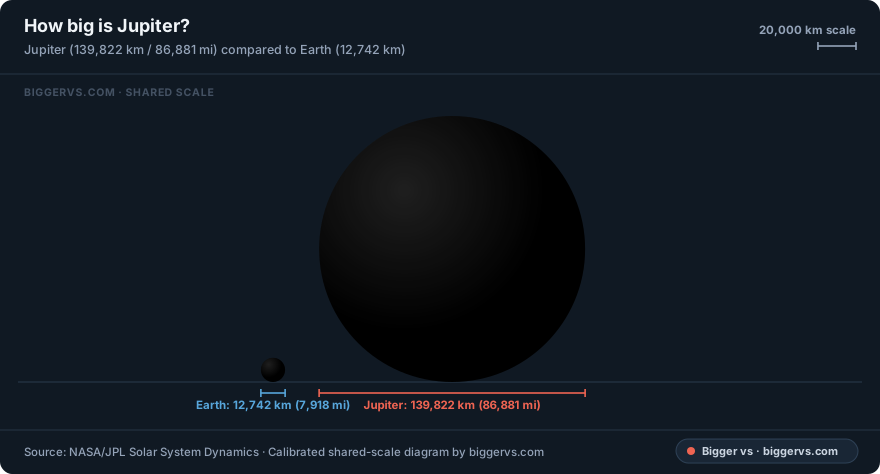
Jupiter’s adopted mean diameter is 139,822 km, calculated from NASA/JPL’s mean radius of 69,911 km. The drawing uses that mean-size globe.
By Bigger vs · Published
Jupiter measures 139,822 km in diameter, about 11× the diameter of Earth (12,742 km).
- Earth
- 12,742 km (7,918 mi)Jupiter diameter is 11× this diameter · Diameter · Diameter across the centre of the mean-size disc.
- Saturn
- 116,464 km (72,367 mi)Jupiter diameter is 1.2× this diameter · Diameter · Diameter across the centre of the disc.
- Neptune
- 49,244 km (30,599 mi)Jupiter diameter is 2.84× this diameter · Diameter · Diameter across the centre of the disc.
Choose the mean-radius column
JPL lists equatorial radius and mean radius separately. This library follows the mean-radius entry and doubles it for a complete diameter. A comparison that mixes one planet’s equatorial dimension with another planet’s mean dimension changes the basis of the ratio. The source links let you check the column before calculating.
Bands identify Jupiter within the measured disc
The stripes and storm-like markings belong to the illustration’s surface treatment. The outside of the globe supplies the diameter. Follow that boundary when judging the size beside Earth or Neptune. The tones assist recognition at small sizes, while the calibrated disc keeps the scale calculation consistent.
A row of Earth diameters is a length comparison
Divide Jupiter’s adopted diameter by Earth’s to obtain the linear ratio shown below. That number tells you how many Earth-diameter lengths span the Jovian diameter. A claim about how many Earth-sized volumes fit needs the cube of the ratio under a spherical model and a clear statement of that assumption.
Measurement and sources
- Adopted measurement
- 139,822 km (86,881 mi) · Diameter
- Measurement basis
- Published measurement
- Scope
- Mean diameter, calculated as twice the mean radius; excludes rings and atmosphere limb effects.
- Measured endpoints
- Diameter across the centre of the disc.
- Source edition and location
- JPL physical parameters table accessed 2026-11-13; radius reference identified in the linked row Named body row, Mean Radius (km). Multiply by 2; do not substitute equatorial radius.
Read the complete measurement record · Inspect the illustration and measuring line · Open standalone SVG scale diagram
Source record checked . Guide reviewed .
Is Jupiter’s 139,822 km figure a circumference?
It is the mean diameter, the distance across the globe through its centre. A spherical-model circumference would be π times that diameter and would be reported as a separate calculation.