How big is the Moon?
The Moon’s mean diameter is 3,474.8 km. It is calculated by doubling the 1,737.4 km mean radius in NASA/JPL’s satellite physical-parameters table.
By Bigger vs · Published
The Moon measures 3,474.8 km in diameter, about 0.3× the diameter of Earth (12,742 km).
- Earth
- 12,742 km (7,918 mi)The Moon diameter is 0.27× this diameter · Diameter · Diameter across the centre of the mean-size disc.
- Mars
- 6,779 km (4,212 mi)The Moon diameter is 0.51× this diameter · Diameter · Diameter across the centre of the mean-size disc.
- Mercury
- 4,878.8 km (3,032 mi)The Moon diameter is 0.71× this diameter · Diameter · Diameter across the centre of the disc.
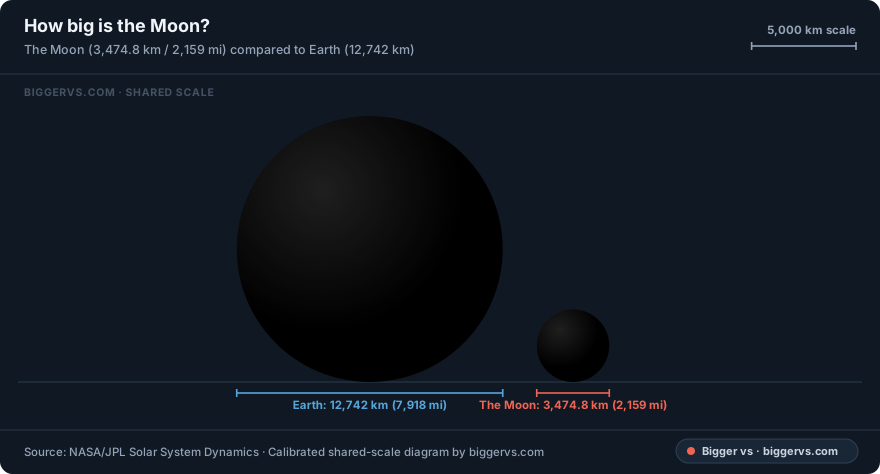
A radius reaches halfway across the disc
The source table gives mean radius. To compare full circular outlines, multiply that radius by two. Using the radius as though it were a diameter would shrink the Moon to half its intended width. The measuring line crosses the complete disc through its centre.
Keep diameter, disc area and surface area distinct
A diameter comparison gives one distance across a body. The circular disc in the picture has area πr². A sphere’s full surface has area 4πr². Those two area calculations answer different questions. Keep the unit visible when a Moon comparison involves a country measured in square kilometres.
Nearby worlds give useful diameter references
Earth, Mars and Mercury offer progressively different scales for the Moon’s disc. All four entries use their named mean-size figures. The drawings put them together as size references. The gaps between the discs provide readable separation and carry no astronomical distance information.
Measurement and sources
- Adopted measurement
- 3,474.8 km (2,159 mi) · Diameter
- Measurement basis
- Published measurement
- Scope
- Mean diameter, calculated as twice the mean radius; excludes rings and atmosphere limb effects.
- Measured endpoints
- Diameter across the centre of the disc.
- Source edition and location
- JPL physical parameters table accessed 2026-11-13; radius reference identified in the linked row Named body row, Mean Radius (km). Multiply by 2; do not substitute equatorial radius.
Read the complete measurement record · Inspect the illustration and measuring line · Open standalone SVG scale diagram
Source record checked . Guide reviewed .
How is the Moon’s 3,474.8 km diameter calculated?
Double JPL’s adopted mean radius of 1,737.4 km. The result is a mean globe diameter. The same source record identifies the radius and measurement convention used for the drawing.