How big is Saturn?
Saturn’s mean globe diameter is 116,464 km, from twice JPL’s mean radius of 58,232 km. The rings extend beyond the globe and are shown separately in the illustration.
By Bigger vs · Published
Saturn measures 116,464 km in diameter, about 9.1× the diameter of Earth (12,742 km).
- Earth
- 12,742 km (7,918 mi)Saturn diameter is 9.14× this diameter · Diameter · Diameter across the centre of the mean-size disc.
- Jupiter
- 139,822 km (86,881 mi)Saturn diameter is 0.83× this diameter · Diameter · Diameter across the centre of the disc.
- Neptune
- 49,244 km (30,599 mi)Saturn diameter is 2.37× this diameter · Diameter · Diameter across the centre of the disc.
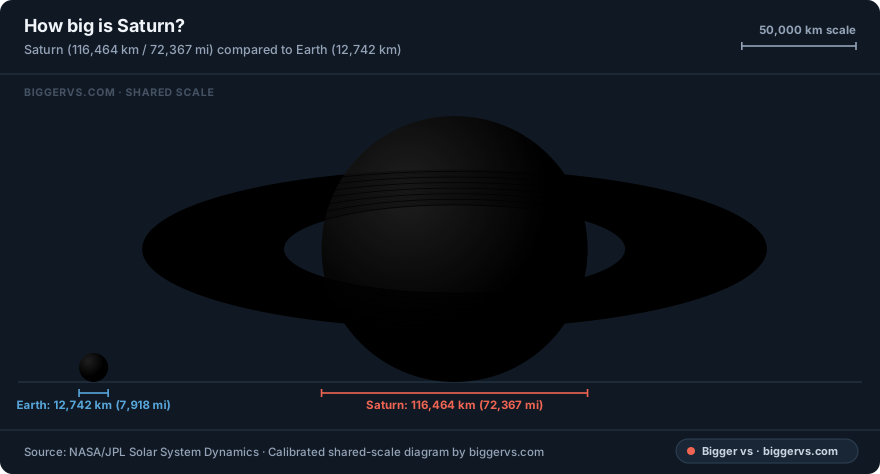
Follow the round globe for the answer
The measuring line follows the body of Saturn through its centre. The wider ring system helps identify the planet and needs additional room in the frame. Use the globe’s boundary to compare the adopted diameter with the other planets. The full outline’s width also depends on how the rings are oriented.
A ring span needs its own named edge
Saturn has multiple rings, so an overall ring diameter requires a stated outer boundary. The artwork’s visible ring extent is documented in the planetary illustration credits. The diameter ratios below use the mean globe figures. When quoting a ring-to-ring measurement, name the ring edge and its separate source.
Check the disc inside the wider silhouette
The ringed outline can initially make Saturn look larger than Jupiter. Compare the round globes at their common scale and use the labels to check the result. The chart leaves space for the entire illustration, including the rings, so you can see the recognizable shape and the measured part together.
Measurement and sources
- Adopted measurement
- 116,464 km (72,367 mi) · Diameter
- Measurement basis
- Published measurement
- Scope
- Mean diameter, calculated as twice the mean radius; excludes rings and atmosphere limb effects.
- Measured endpoints
- Diameter across the centre of the disc.
- Source edition and location
- JPL physical parameters table accessed 2026-11-13; radius reference identified in the linked row Named body row, Mean Radius (km). Multiply by 2; do not substitute equatorial radius.
Read the complete measurement record · Inspect the illustration and measuring line · Open standalone SVG scale diagram
Source record checked . Guide reviewed .
Are the rings included in the 116,464 km diameter?
The 116,464 km value measures the mean globe diameter. The rings are an additional visible extent. A ring diameter requires its own endpoint definition, such as the outer edge of a named ring.